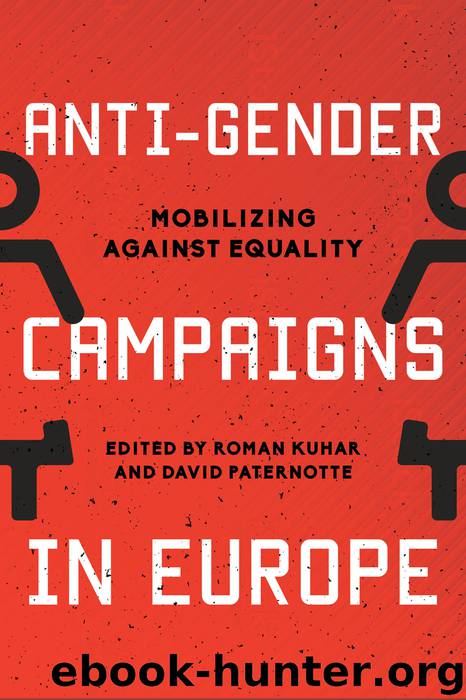
Anti-Gender Campaigns in Europe by Roman Kuhar
Author:Roman Kuhar
Language: eng
Format: epub
ISBN: 9781786600011
Publisher: Rowman & Littlefield International
CONCLUSION
Much of the activism on LGBT rights and women’s rights in Ireland, especially in relation to reproductive rights and same-sex marriage, has focused on constitutional change. This stems from the historical nature of the Irish state, as law and social policy in the areas of reproductive rights and sexuality were dominated by Catholic social thinking. The Irish state, which came into being in 1922, accepted the mores of Catholic ideology in legislation and in the Constitution: It formalized and legitimized these ideologies with its constitutional ban on abortion and its defence of traditional marriage. This meant that, in essence, the wars between those who sought to liberalize these laws and those who sought to preserve them were fought through legislative change and through the Constitution. In Ireland, the next battle will be the campaign to repeal the Eighth Amendment from the Irish Constitution.21 As David Quinn of the Iona Institute, said in anticipation of the battles to come: “Those seeking abortion will be hugely emboldened by what happened on Friday (22 May 2015). At the same time, however, many politicians will know that the 38 percent of people who voted against same-sex marriage can be turned into a majority opposed to deleting the Eighth Amendment (which bans abortion)” (cited in Kelly 2015).
The defence of the Catholic identity of the Irish state, especially in its control of women’s reproductive bodies, is the final battleground. Ireland was constructed, from its foundation, as a Catholic state for a Catholic people, and so the dismantling of that has to happen through amending Constitution and changing legislation. In reality, this is about disentangling the ties that bind the Church and state together. These ties have been undermined and are slowly unravelling but many remain, especially though the control of women’s bodies, through resistance to further LGBT rights and through Church control of the education and healthcare systems.
While, “gender ideology” has not formed an overt part of that battle for legislative change, the language used reflects or mirrors the language of anti-gender campaigns in Europe, although usually couched in terms of resisting feminist or left-wing agendas. However, there are signs that “gender ideology” will form a more definite part of future debates, especially as transgender rights are now an issue in Ireland. In an article written in 2015, David Quinn condemned “gender ideologues (who) believe that gender is a social construct, pure and simple”. In “this brave new world” advocates of “gender ideology” “want us to believe that categories of male and female exist mostly in our heads, and are not an intrinsic, basic and fundamental element of what it means to be human” (Quinn 2015). Quinn wrote this to oppose any pro-trans policies, including a school program for junior students, Different Families, Different Love, which he wrote, would teach “junior infants (4/5 years olds) about transgenderism” (Quinn 2015).
Defending Catholic Ireland will continue to motive the Church and its lay allies. In particular the attempts to remove primary- and secondary-school education from its control will be strongly resisted.
Download
This site does not store any files on its server. We only index and link to content provided by other sites. Please contact the content providers to delete copyright contents if any and email us, we'll remove relevant links or contents immediately.
| General | Discrimination & Racism |
Nudge - Improving Decisions about Health, Wealth, and Happiness by Thaler Sunstein(7715)
The Fire Next Time by James Baldwin(5458)
iGen by Jean M. Twenge(5422)
Adulting by Kelly Williams Brown(4586)
The Sports Rules Book by Human Kinetics(4406)
The Hacking of the American Mind by Robert H. Lustig(4390)
The Ethical Slut by Janet W. Hardy(4270)
Captivate by Vanessa Van Edwards(3846)
Mummy Knew by Lisa James(3700)
In a Sunburned Country by Bill Bryson(3550)
The Worm at the Core by Sheldon Solomon(3495)
Ants Among Elephants by Sujatha Gidla(3475)
The 48 laws of power by Robert Greene & Joost Elffers(3325)
Suicide: A Study in Sociology by Emile Durkheim(3029)
The Slow Fix: Solve Problems, Work Smarter, and Live Better In a World Addicted to Speed by Carl Honore(3018)
The Tipping Point by Malcolm Gladwell(2939)
Humans of New York by Brandon Stanton(2880)
Get What's Yours for Medicare: Maximize Your Coverage, Minimize Your Costs by Philip Moeller(2793)
Handbook of Forensic Sociology and Psychology by Stephen J. Morewitz & Mark L. Goldstein(2718)
